
Industrial robots place unusual demands on cable protection because the harness does not remain in one position. Each movement can repeatedly bend, twist, compress, and reposition power, signal, and pneumatic lines around multiple joints. Unlike static installations, the protective conduit must accommodate motion without interfering with the robot’s programmed path.
A nylon corrugated tube provides a flexible protective layer around these lines, while DEKUMA develops extrusion equipment for producing lightweight, durable, heat-resistant corrugated tubing used in demanding applications.
Why Robot Arms Need Dynamic Cable Protection
Static cable protection mainly deals with abrasion, contamination, impact, and installation conditions. Robot arms add another variable: repeated movement. A cable bundle may travel through the same bending zone thousands or millions of times, making bend radius, flexibility, and fatigue resistance important considerations alongside basic mechanical protection.
Joint geometry determines how the harness moves. A cable routed around a shoulder or wrist joint can experience alternating bending, while another section may undergo torsional movement as the end effector rotates. These motions are not necessarily distributed evenly across the conduit. Certain sections can become recurring stress points, particularly where clamps, connectors, or routing brackets restrict movement.
The protective structure must also avoid excessive friction against the cables inside. If the conduit repeatedly changes shape during robot operation, its internal surface and corrugation profile influence how the bundle shifts. Excessive restriction can increase mechanical loading, while insufficient support may allow the cables to move unpredictably. Cable management is consequently a system-level issue rather than simply a matter of covering individual wires.
How Corrugation Supports Repeated Flexing
The alternating ridges and valleys of corrugated tubing provide a useful combination of flexibility and protection. Compared with a rigid smooth conduit, the profile can deform through repeated bending while maintaining a defined protective path around the harness. This characteristic becomes particularly valuable near articulated joints where available installation space changes continuously.
Material selection affects the response of the protective sleeve. Nylon grades are valued in industrial applications for their mechanical properties, abrasion resistance, and ability to operate across demanding environmental conditions. The exact compound, however, should be matched with the robot’s temperature, chemical exposure, bend cycle, and mechanical requirements rather than selected solely from a generic material label.
Corrugation geometry matters just as much. Pitch, wall distribution, diameter, and bending characteristics influence how easily the tube follows a programmed robot trajectory. A conduit that is too stiff can impose additional loads on the harness, whereas one with insufficient structural support may provide weaker protection around moving sections. The appropriate balance depends on the robot architecture and the number and type of lines being routed.
Extrusion Requirements for Robot Cable Conduit
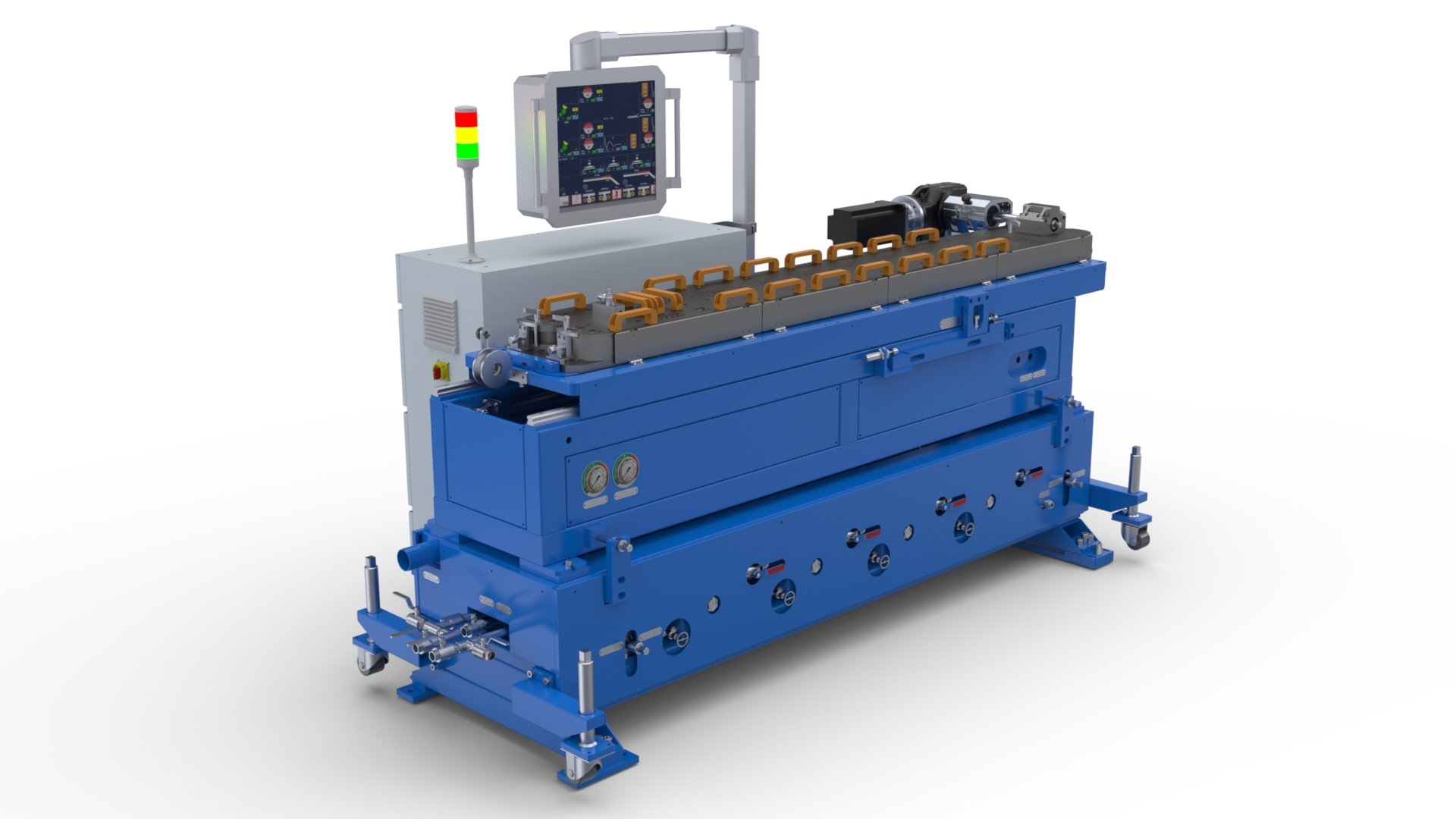
Production consistency becomes particularly relevant when a protective tube must repeatedly flex through the same motion cycle. DEKUMA’s PA tube extrusion machine is designed for lightweight, durable, heat-resistant corrugated tubes and is positioned for applications involving new-energy vehicle cooling systems. Its multi-layer extrusion capability also illustrates how different material characteristics can be incorporated into specialized tubing structures. The basic need for controlled geometry remains unchanged.
For a corrugated pipe making machine, dimensional stability is more than an appearance issue. Variations in diameter, wall thickness, or corrugation formation can alter bending behavior from one production length to another. Consistent forming and cooling help keep the finished conduit within the intended dimensional range, which is important when the tube must fit clamps, routing guides, connectors, or other cable-management hardware.
Robot applications also benefit from evaluating the finished tube under realistic movement rather than relying only on static inspection. Bend-cycle testing, torsional movement, abrasion assessment, and resistance to environmental exposure can reveal weaknesses that may not appear during dimensional checks. The testing method should reproduce the actual movement profile as closely as practical, including the bend radius and speed encountered during robot operation.
Specification Differences Between Static and Robotic Systems
Static installations generally prioritize protection against external conditions and straightforward installation. Once fixed, the conduit experiences relatively limited geometric change. Robot-arm routing is different because the protection system itself becomes part of a moving assembly, so flexibility and fatigue behavior become central specification factors.
The cable bundle should be evaluated according to its complete movement envelope. Engineers need to consider the robot’s joint angles, axis rotation, acceleration, end-effector movement, and routing constraints. A conduit that performs well in a simple bending test may behave differently when bending and twisting occur simultaneously around a compact wrist assembly.
Other factors can further modify the selection. Welding robots may encounter sparks and elevated temperatures, machining robots can operate around oils and metal debris, while assembly robots may require tighter routing around sensors and pneumatic components. The protective tube must suit the environment without restricting the intended motion of the harness. Such application-specific assessment distinguishes robotic cable management from ordinary fixed conduit installation.
Conclusion
Reliable robot cable management depends on how protection behaves in motion, not simply how it performs while stationary. Repeated bending, torsion, abrasion, joint clearance, and environmental exposure all contribute to the service conditions experienced by power, signal, and pneumatic lines. Corrugated construction offers a practical way to combine flexibility with a defined protective structure, but its geometry and material still need to match the robot’s movement profile.
Production quality has a direct connection to that engineering requirement. Stable dimensions, consistent corrugation, suitable material behavior, and appropriate testing provide a stronger basis for evaluating conduit performance over repeated cycles. The result is a specification built around actual robot movement rather than assumptions derived from static cable installations. DEKUMA supplies extrusion technology for specialized corrugated tubing applications, supporting manufacturers that need controlled production of flexible protective conduit for demanding industrial environments.